
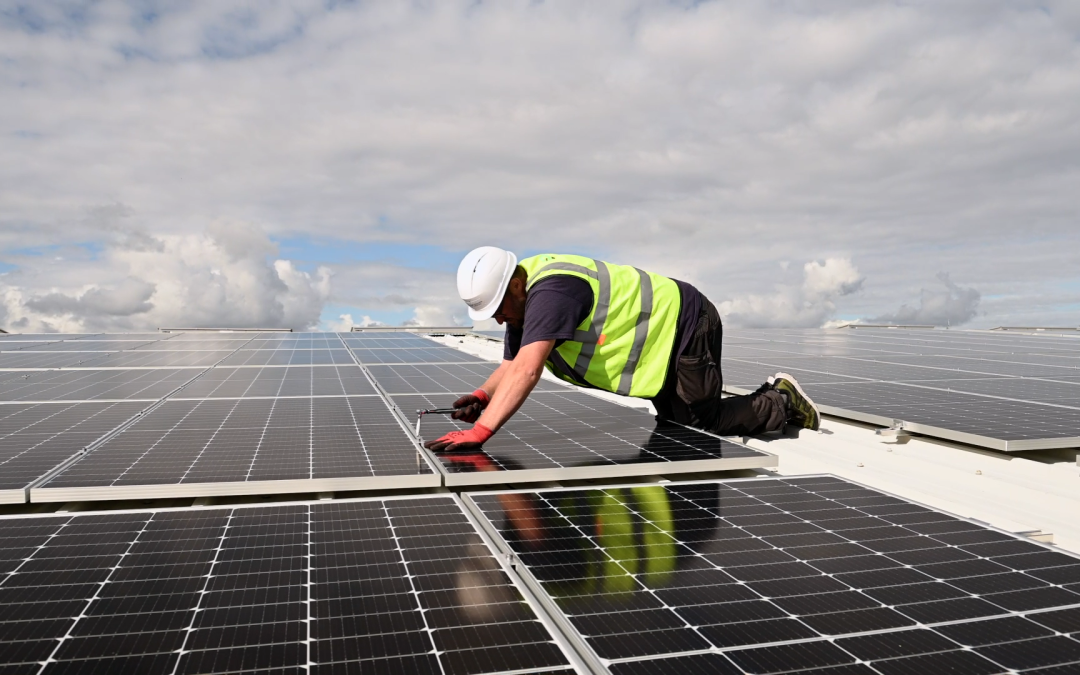
From the moment you contract a solar PV project to the day we hand over your completed system, a complex but carefully orchestrated process ensures your installation is designed, built, and ready to deliver decarbonisation and cost benefits for your business.
We achieve 99% on-time delivery through rigorous front-end planning, collaborative design processes, and relentless communication throughout every project phase.
In this blog, Operations Manager Mike Wilde takes you through exactly what happens behind the scenes of a commercial solar installation.
The Front-End: Setting up Projects for Success
Most clients assume the hard work begins when installation teams arrive on site. In reality, the most intensive phase happens in the months prior, and it’s what determines whether your project finishes on time or descends into delays and variations.
Pre-Contract Site Surveys
Before any contract is signed, we commission detailed surveys to assess the site’s structural capabilities and whether it can support the PV panels. This pre-contract work ensures we reach the “Right to Build” stage the point where we know the project is feasible and can commit to delivery with confidence
Our structural engineers calculate snow loading in valleys, check the structural integrity of the proposed site, and identify any areas where panels cannot be installed. We get a full structural report every time as relying on assumptions is a huge risk that could push programmes back.
Simultaneously, we survey all electrical infrastructure, including your incoming mains supply, distribution boards, and breaker capacity. If your system requires an 800-amp connection point, we verify whether your panel can accommodate it or if upgrades are necessary before finalising the design.
Multiple Design Iterations
Here’s something most clients don’t realise: we typically go through four to five design iterations on straightforward projects. Complex installations like Euro API? Twenty-three design changes.
Each iteration refines the system based on new information. The structural survey might reveal that we can’t fit panels in certain roof areas. The electrical survey might determine that we need to reduce the system size to match available capacity. DNO applications (which run in the background for 90 days) might return with connection costs or restrictions that require redesign.
This iterative process is borne from the technical precision of our design team. By the time we finalise the design, we’ve accounted for every variable. The result? Installation teams arrive on site with a complete and comprehensive pack of information and no questions.
The Critical Pre-Installation Period
The two weeks before installation are the most intense for our team. We’re finalising AC and DC cable designs, confirming all equipment orders, coordinating material deliveries, organising welfare facilities, and pulling together comprehensive contract packs.
This is where meticulous coordination is essential. Every detail must be perfect because once installation begins, changes become expensive. I meet with our design and installation teams to review the final design together, catching potential issues on paper rather than on site. We’ve found that the early, data-led work and design refinement mitigate most problems, and we are good to go.
Collaboration and Supply Chain Excellence
What separates successful solar projects from problematic ones? Integrated teams working with complete information.
Comprehensive Contract Packs
When installation teams arrive on site, they receive 40–50-page contract packs detailing every aspect of the project. Every detail is clear, accessible, and easy to understand on site.
Each roof section gets expanded over multiple pages for clarity. Cable routing is detailed precisely. Containment requirements are specified, setting out details in line with manufacturer specifications, ensuring warranty compliance.
Our installation teams consistently provide feedback that this level of detail enables them to deliver efficiently without variations or delays.
Trusted Supply Chain Relationships
We work exclusively with some of the best suppliers in the business who know our specifications and standards. When we contact a supplier about a PV panel or an inverter, they already know what we require.
Years of collaboration have built an incredibly robust supply chain that anticipates client needs. Our suppliers understand our quality standards, delivery timelines, and technical requirements. This means faster responses, reliable availability, and proactive problem-solving when specifications need adjustment.
For clients, this translates to predictable delivery schedules, consistent quality, and confidence that materials will arrive on time without programme delays.
Legitimate Variations Only
Because of this intensive preparation, variations are rare, and when they occur, they’re legitimate. You won’t get charged for details we should have caught during surveys. If we request a variation, it’s because something genuinely unforeseeable emerged, not because of the level of detail during planning.
On-Site Delivery: Communication and Quality
Once installation begins, success depends on dedicated project management and transparent communication.
Full-Time, Dedicated Project Managers
When our Project Managers manage your project, they’re on site from day one until the last piece of temporary fencing is removed. They communicate with your on-site team daily to understand your operational requirements, coordinate around shift patterns, and manage access restrictions.
For live sites (which most of our projects are), this daily dialogue is essential. Client operations change. Important visits get scheduled. Deliveries need to be coordinated. Without constant communication, minor issues can turn into major delays.
Managing Live Operational Sites
Working on active warehouses, distribution centres, or occupied facilities requires an intimate understanding of client operations. We factor in security protocols, whether that’s a 20–30-minute phone clearance process at a distribution centre, coordinating with live ammunition operations on military bases, or simply working around restricted access times. We adjust programmes when client priorities shift.
Quality Verification Throughout
Throughout installation, we use detailed checklists for every project phase. These are signed off by our installation team, project managers and your team, creating shared accountability.
By the time we reach final snagging, our contractors have already identified and resolved most issues. We’re checking work, not discovering problems at this stage, because quality has been monitored continuously.
Why This Process Matters
Three months of intensive front-end work enable smooth installation. Comprehensive contract packs prevent on-site confusion. Collaborative design catches problems before they’re expensive. Dedicated project managers maintain the programme even when circumstances change.
This is why 99% of our projects are completed on time. It’s why clients choose us time and again for multi-site rollouts. Our process builds trust, and clients know exactly what to expect, when to expect it, and that we’ll deliver. This reputation for quality and reliability is making us the go-to delivery partner for commercial solar across the UK.
Ready to experience the Lynx Sustainable Solutions approach? Contact our team to discuss your commercial solar project.
Recent Comments