
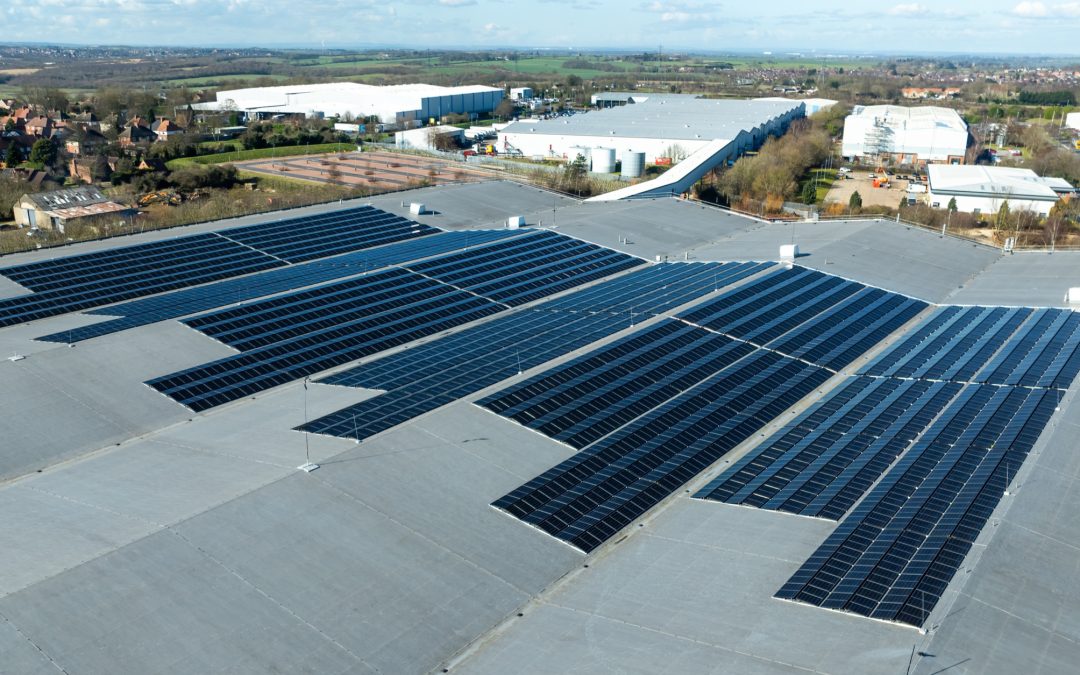
Depending on what your warehouse does, your energy usage will differ greatly from that of other commercial buildings, such as shops and offices. Many of you will be operating outside normal business hours, relying on shift patterns, and you are probably running production lines, robotic picking systems, and EV forklifts, all of which increase your energy consumption.
That kind of high-volume demand leaves a UK warehouse operation far more vulnerable to the energy market and global politics.
Looking Past the Upfront Cost of Solar
James Wakelin, head of sustainability at Indurent, one of the UK’s larger warehousing landlords, made the case plainly earlier this year: wholesale gas prices rose by roughly 75% in a single month last year. For a warehouse running high, near-constant loads, that kind of swing constricts margins and makes forecasting for the year ahead genuinely difficult. Indurent’s own portfolio, using on-site generation, has achieved at least 10% reductions in electricity costs, and the fully installed cost of commercial solar has fallen by around 70% over the past decade. The economics have moved significantly in favour of solar for warehouse assets, particularly as international events continue to expose the economy to volatility.
Despite evidence of lower energy costs and reduced installation costs over the last 10 years, warehouse operators still hesitate due to upfront costs. That’s why CapEx is the wrong metric for this decision, as it tells you nothing about what you’ll be paying the grid in year eight or year 15 or when the next price shock or international crisis hits. For a warehouse specifically, the more useful question is how much of that constant, high-volume load you can take off a volatile grid and put onto a fixed, predictable source instead for the next 25 years.
Getting the System Right from the Start
You can’t size a system up on the warehouse roof area alone, as aligning generation with when the building needs it matters. It’s a system sized to the shape of the demand it serves. A site running heavy loads across two or three shifts needs a different balance of generation, export, and on-site consumption than a site that’s quiet by early evening. Get that wrong, and you end up with a system that’s either underused during the hours it matters most or exporting excess generation for which you’re not being paid a sensible rate.
This is where design experience in warehousing specifically is vital. We’ve delivered rooftop solar across distribution centres, cold storage, and manufacturing sites with very different operating patterns, and the sizing conversation looks different every time.
You need the system to keep pace with demand when it matters most. We start by looking at half-hourly consumption data to interpret the demand by shift pattern and help you understand the balance between the grid and onsite generation. For sites with night shifts, that often means considering battery storage to make the most of daytime generation.
Factoring in Room for Growth
Solar gives you cost certainty on the load you design for, but that won’t stop your growth plans. With changes in demand and innovation, warehousing tends to grow and evolve faster than many other parts of the economy. We know from the outset of a project that you are likely looking to increase automation to improve productivity. That you are considering EV fleets and yard equipment, which will add extra charging demand. You may have a tenant with additional refrigeration needs, so your asset use case has changed.
A system sized tightly to today’s consumption can find itself undersized within a few years; that’s why switchgear, cabling, and inverter capacity are specified for future demand based on your growth strategy.
Momentum for Solar as Part of Warehousing’s Future
The case for solar on warehouses is clear and is being made at the industry and government levels. The UK Warehousing Association (UKWA) has spent the last four years, since commissioning its 2022 research paper on the investment case for solar, lobbying members to treat their roofs as assets. They believe so strongly in solar’s potential to transform warehousing that they have played an active role in the Solar Task Force and contributed to the UK Government’s solar roadmap. This has led to the launch of the UKWA’s solar toolkit last year, with a foreword from the Minister for Energy, Michael Shanks MP.
With energy prices impacting profit margins and being passed on to consumers, and green premiums and brown discounts shaping how a building is valued, a warehouse with solar in place is worth more than one without.
Is it time to see how solar can positively impact your warehouse or logistics operation? Please get in touch.